Showing posts with label Kimberlee. Show all posts

Monday, February 23, 2015

Kimberlee Kuhle Supplemental Post #1

While watching the Oscars last night, it became extremely clear that a majority of the excitement for the night revolves around what the stars- mainly the women- are wearing. These talented and hard-working women are bombarded with the same questions by reporters and journalists about who they are wearing, what their nails look like, etc., instead of being asked more creative and meaningful questions. I can't lie- one of my favorite parts of the Oscars is seeing all of the beautiful gowns everyone wears. On the other hand, although I love seeing the dresses, during the interviews with the actresses, it would be nice to hear a question other than, "So who are you wearing tonight?" and "How long did it take you to get ready?" The Representation Project thought the same thing, and created a social media campaign for awards season called #AskHerMore, which insists that questions on the red carpet are overtly sexist, with women almost only being asked about what she is wearing, and urges reporters to start asking more meaningful questions.


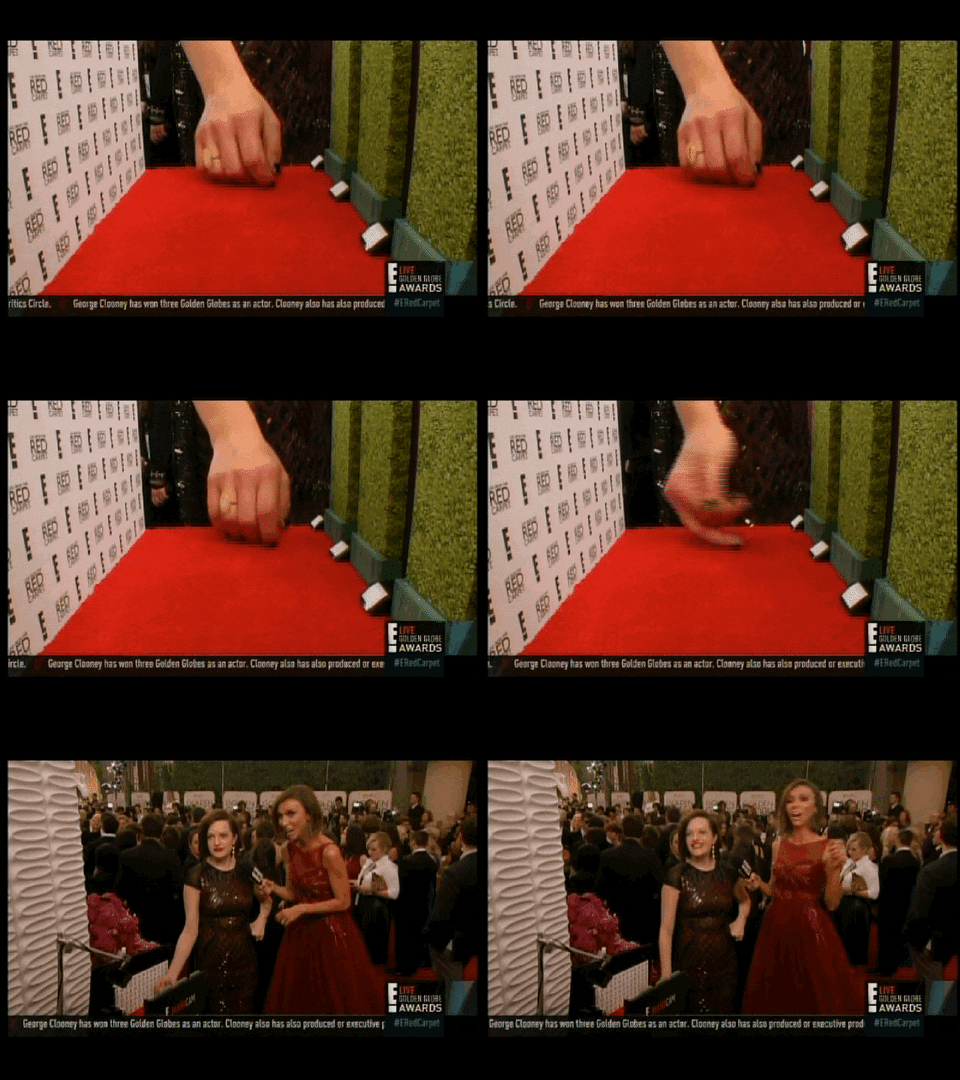
The Representation Project is a non-profit organization run by Jennifer Siebel Newsom, and its goal is to change the way women are represented in the media. The campaign was launched in February 2014, and was sparked by E! News' infamous mani-cam. The mani-cam was a small camera set up and angled on a mini red carpet that had stars show off their manicure and jewelry. 

Many celebrities were not thrilled with the mani cam at all, and at the Sag Awards this past year, stars like Jennifer Aniston and Julianne Moore refused to participate, and Elisabeth Moss even flipped off the mani cam. After these incidents, the mani cam has seemingly been removed from the red carpet.


Reese Witherspoon, Amy Poehler, Lena Dunham and many more celebrities have shown support for the #AskHerMore initiative for reporters to ask women in entertainment about their careers, rather than only about what they are wearing. On the carpet at the Oscars, Reese Witherspoon told Robin Roberts: "This is a movement to say we're more than just our dresses. There are forty-four nominees this year that are women and we are so happy to be here and talk about the work that we've done. It's hard being a woman in Hollywood, or any industry." 


I think that this campaign is very meaningful and important, and is happening at a great time because even though gender equality has always been a problem, it is a hot topic right now, with more female stars than ever before taking a stand and speaking out about this issue. Additionally, I really like the campaign because it is not asking for much and is very easy for reporters to do, but the outcome will be extremely effective and positive for women. The women who are being celebrated at these events have worked so hard to get where they are, and although people want to know about what they are wearing (and still can), it is important for these women to have the opportunity to show their intelligence, speak about charitable organizations, speak about the several aspects of their career, etc. 


Monday, February 2, 2015

Kuhle 2/3/15 Reading Core Response #1

In Maria Laplace’s “Producing and Consuming the Woman’s Film,” she speaks about how cinema throughout history constructs female subjectivity and female desire. Laplace specifically touches on consumerism, the image of the star, and women’s fiction, and then discusses how these discourses are apparent throughout the film, Now, Voyager. I thought that it was very interesting to learn about the roots of consumerism and how women have always been the targets for mass-produced commodities. It is pretty mind blowing that as early as the 1920’s, advertisements have targeted women in regards to their looks in order to sell a product. Beginning then, and continuing today, the notion that beauty is something that is achievable with the right products, and that the identity and one’s happiness and acceptance is based on what others think of you, has been ingrained into the beliefs of our society, and as Laplace comments, is reflected in films. In the film Now, Voyager, Charlotte is considered mentally sick primarily due to the way she looks because she is overweight, does not wear makeup, and does not have fashionable taste in clothing. During her time as being “unattractive,” she is constantly judged, does not have a voice, scrutinizes herself, and does not have the love of a man. Once she undergoes her glamorous transformation, she immediately becomes an object to be gazed upon- due to both her beauty transformation as well as her clothing- and also receives the love of a man who would have otherwise not given her the time of day. This message is constantly reflected in television, film, and advertisements today.


Additionally, celebrity culture has enhanced consumerism today, and truly taken it to another level. It seems that no matter where we look today, there is a message about beauty and what one needs to do or have in order to be beautiful, loved, and accepted. In film and television, we are constantly berated with the idea that in order to be happy, a woman must have the best clothes, hair, boyfriend, etc. For example, the popular shows Gossip Girl and 90210 are examples of this message, as well as examples of how the celebrity culture has influenced consumerism. When these shows were on the air, the main and popular characters were all known for having the most amazing style and beauty products. Therefore, brands were constantly fighting to get their name on screen, and websites were created so that fans could replicate the style they had seen on the show. I’m not going to lie, I have definitely watched an episode of Gossip Girl, and as a huge fan of Blake Lively, have looked up what she was wearing in hopes of finding it or something similar. This truly shows the power of advertising and the power of celebrity on our culture today. Since we have become so accustomed to these images, I think that it is really important for consumers to be aware of the images we see and realize the power that they have.