Saturday, February 21, 2015

Supplementary Response #1

As a student whose background is from Korea, I am not only familiar about the Hollywood stars and the entertainment system but also Korean entertainment. Recently, I have been comparing the two different countries and cultures' fan culture.

I will be dividing my observations of the two different fan cultures into three sections:

a. Gift-giving
b. Home master
c. Community (a.k.a. fan club)

Today, I will be talking about a. Gift-giving.
In Korea, there is a tradition that has developed called "조공" (Jo Gong).
Its root goes back to when Korea was seen as a sub-country of China.
In order to maintain good relationship with the bigger country, Korea would send various goods to the Chinese emperor.
Nowadays, the word is also being used to describe the act of Korean fans supporting their stars by presenting them with various goods. There are two big occasions where the fans give the stars Jo Gong: birthdays and sets.
Before their stars' birthdays, the fans, usually in groups of community (either in fan clubs or in supporting websites), comply money to buy presents. The presents range from artworks done by fans to even an IMac computer. Some fans would post advertisements throughout Seoul, such as on buses, subway stations, and newspapers, to celebrate the occasion.


Jo Gongs gifted to a star by a certain fan club which includes comic books, cosmetics, tea, humidifier, wine, and snacks


Jo Gongs gifted to a star by a certain fan club which includes stereo, TV, Macbook Pro, perfumes, sunglasses, wines, vitamins, snacks, and jewelries 


Ad created to celebrate a star's coming of age day at a subway station


Birthday advertisement for a star by a fan union


HOW FAR WOULD YOU GO?


1. One fan of an idol group found out that her star loves English Premier League, especially the player Fernando Torres. Even though she does not speak English, she sent a letter to Torres to explain her star's upcoming birthday. Torres, after reading the letter, sent an autographed ball and shirt to the fan, which she gave it to the idol group member in his birthday. In a way, the fan linked the star (member of the idol group) to his star (Torres)!


2-a. Some stars are known to not receive physical presents for their birthdays. Rather, they encourage the fans to do good in the world. Still, some fans do Jo Gong by philanthropy, such as donate money in their stars' name. 


2-b. Example of Jo Gong that has philanthropic meaning (creating forest in Seoul in the star's name)


Fans also support their stars when they are shooting a new drama or movie (for singers and Idol groups, for their new album). To wherever their stars are, in different stations or sets in the countryside, the fans would usually prepare food for not only their stars, other stars in the case of drama and movie shoots, but also for the whole staffs. They do this in order to not only feed their loving stars but also to entrust their stars come out well on screen by the happy, non-hungry staffs. The act of Jo Gong to these numerous staffs ultimately benefits the stars, giving them good image and the good quality of their performances.


Jo Gong prepared for staffs, co-stars, and the star to eat during a drama shooting


Jo Gong (gift box filled with hand creams and other goods) for the staffs being prepared


Stars, or the entertainment company, would then post the stars with the Jo Gongs, which certifies that they have received the fans' presents.


Idol group member taking selfies to show that she received the Jo Gong


Star taking a selfie in the moment of enjoying the Jo Gong


I think this is an unique fan culture of Korea. So far, I have not seen any U.S. fandom who would organize such support to its stars. There is a case of stars doing the vice versa. It is called "역조공" (Yuk Jo Gong--yuk meaning reverse), where stars would prepare gifts to their fans. Although they cannot give presents to all their fans, they would prepare food or small gift to share with the ever-supportive fans. Some stars in the U.S. also Yuk Jo Gonged to their fans. Recently, Taylor Swift gave random fans Christmas presents, which included a 2014 London Victoria's Secret Fashion Show duffle bag stuffed with exclusive merchandise, a Fujifilm Instax Mini 90 Polaroid camera with four packs of film and picture frames, bath and beauty products from Australia, Brandy Melville apparel, a large stuffed animal fox, blankets, throw pillows, candles, $200's worth of gift cards, and a Christmas sweater (Wang, Billboard). It seems universal for stars in both countries to show their appreciation to their fans by giving them presents. The joy of the fans who receive these would also be universal to the U.S. and Korean fans.


Members of an Idol group hand-wrapping the Yuk Jo Gong gifts


Same Idol group presenting the fans who are waiting to watch their performance food


Some fans who have received the Yuk Jo Gong from their stars would post the gift on their fan club community or even on their SNS


Capture of Taylor Swift wrapping gift boxes for fans


Thursday, February 19, 2015

Supplemental Post #2 - British Actors in Hollywood

Last year, Jaguar released a Super Bowl ad that featured Sir Ben Kingsley, Tom Hiddleston, and Mark Strong. Directed by Tom Hooper of The King’s Speech, the advertisement explores why Hollywood “bad guys” are often played by British actors. From Jeremy Irons voicing Scar in The Lion King to Sir Ian McKellan as Magneto in the X-Men films, a British accent has become Hollywood shorthand for “evil genius sociopath that has plans to rule the whole world” or simply, “the bad guy.” Even in the film we watched last week, North by Northwest had a British antagonist. No doubt, Brits have been portrayed as the “bad guys” since early films.


 In the ad, the actors--who are all known to play the movie villains-- speak to the camera and posit that Brits make the best bad guys because: “we’re more focused,” “we have a certain style,” and “maybe we just sound right.” But why is that?

 Like what Helen Mirren said at an event, “I think it’s rather unfortunate that the villain in every movie is always British, we’re such an easy target that they can comfortably make the Brits the villains.” There could be many reasons why Brits seem to always portray the antagonists. One possibility is that, perhaps through the teaching of history in schools, Americans have a brooding resentment of the way the British ruled the colonies (which ultimately resulted in the American Revolutionary War). A history of oppression and colonization meant that much of the world had a good reason to classify this sort of establishment English as an accent of evil. After all, at various points in history, the British had invaded many countries and developed an extensive empire—and it seemed that the world feared them. So history might have played a part in the translation and adaptation of these British "bad guys" onto the screen.

 But recently, more and more British actors have begun to transition their “evil/malevolent” roles to the “hero/heroine” roles—with more Brits playing lead American roles. It is said that a British actor is more humble and less egoistical than an American actor—and hence, easier to work with. However, those are just industry rumors (I personally believe it depends on the actor's personal character). But even so, many British actors have been classically conditioned (in theatre most of the time) and hence, more "versatile"—which could be a reason why there is a prominence of British actors in Hollywood. Nonetheless, no matter where they are from, actors are chosen for their roles by their talents; it is just that Hollywood is experiencing a great wave of rising stars hailing from the U.K.

Monday, February 16, 2015

Different Definitions to Masculinity (core post #1)


The cast, the script, the costumes, the lighting, in short; all the materiality of film language is structured to tell a story endowed in certain conventions, such as gender constructions of men and women, protagonists as good and antagonists as evil, etc. The construction of gender in cinema and its representations have changed over time - as well as other aspects of cinema – and since 1960 margins became blurry, less dichotomous and more complex and ambiguous. Hitchcock, who imposed a very particular style and way of subversive expression, anticipated the crisis of sexual roles in his films since 1940s. On the other hand, John Wayne represented a completely different image of masculinity that was based in other principles and that served different political reasons.

The words male and female only exist because of each other; the meaning of one depends on the other. The concepts of masculinity and femininity reproduce a set of characteristics, values and behaviors, considered by a given society and culture as appropriate for men and women. An individual’s gender identity may be the result of the ways he expresses himself through his physical appearance, manner of dress, social activities and many other factors, all determined by society as masculine or feminine traits. This identity however, is constructed and transformed. And the social, technological, political and economic changes cause alterations in the constructions, definitions and meanings of identities, since individuals are within these transformations. 

John Wayne

John Wayne was a Hollywood movie icon between the years 1927 and 1976; he worked as an actor, mainly in the Western genre, and eventually became a major reference for men. Strong-looking, rude and always wielding a rifle, he was a defender of the weak and helpless women, especially in the American West. Wayne is the typical male model of bourgeois society, from the industrial revolution, associated with strength and virility. Attributes, linked to the idea of a male provider coming from patriarchy, determine the configuration of the "real man" that he represents. This had repercussions nationwide, causing a major political and social impact in most Americans. In a time of much despair and lack of hope, John Wayne was the light in the end of the tunnel; he represented everything every guy in the US at that time wanted to be. Which is why he set a standard that later on became known as the “John Wayne Syndrome”. His "invincibility" further advanced the idea that he stood for something that many people thought had disappeared and longed for. 


This video echoes the standard John Wayne that is represented in all of his movies and that contributed to enhance the standard of masculinity at the time, based on concepts such as honesty, sincerity, courage, honor and manhood with restrictions on the expression of affection and emotions. 

In the text, Willis portrays John Wayne as a symbol of masculinity for generations of Americans – something that he calls the embodiment of an American Adam. However, this view of Wayne as a beacon for hope is slightly underwhelming for me considering the discrepancy between Wayne’s public posture of a hero and his private life that showed the contrary. Wayne was the representation of a hero that indirectly forced many generations to sacrifice their lives in wars like Vietnam, whilst he managed to cleverly escape from serving in World War II. This shows that Wayne created a film persona that had a hidden political agenda. I thought it was very interesting how Willis noted the ways in which stars act as magnets and catalysts of own feelings, which made it even more important to impose Wayne as a vehicle to push America forward. The prologue notes how Wayne’s persona differs from the super vindictive macho such as Dirty Harry and Rambo, and also differentiates Wayne's status as an authority figure of rebel heroes like Bogart and Cagney T.

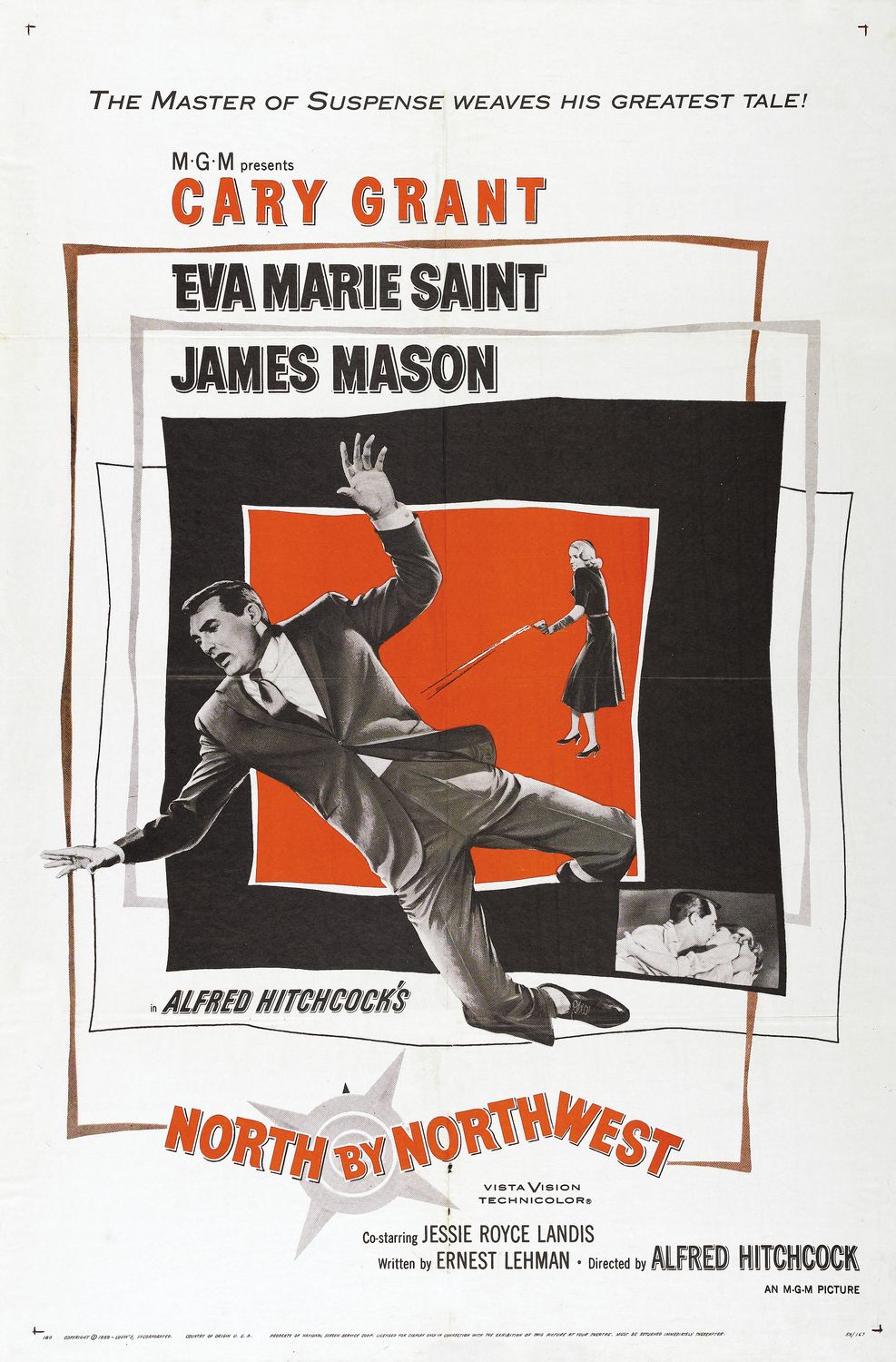
Hitchcockian cinema takes a different look at masculinity, challenging its structure and shifting ideas about what it means to be a man.  He puts into crisis these gender categories, scrambles the distribution of sex roles and builds sexually ambiguous characters since 1940. These gender categories can be seen through the costumes and narratives. His challenge to a topic that used to be very classified, is one of the many reasons why Hitchcock movies revolutionized Hollywood’s standards. Cary Grant in North by Northwest proposes a new idea of masculinity that by no means is any less powerful than John Wayne’s, just different and ahead of society’s beliefs and ideals. As pointed out by Steven Cohan, the poster itself already depicts male vulnerability with Cary Grant hanging and falling.  This movie shows how the representation of masculine and femininity in cinema, before two opposite and separate categories, can be nuanced.


“Masculinity Crisis” – More Like Gender Breakthrough! (CORE POST #2)

“Masculinity Crisis” – More Like Gender Breakthrough!

I have a serious issue with the way Steven Cohan, writer of Masked Men: Masculinity and the Movies in the Fifties,  has analyzed the male condition in American society. Cohan uses the 1959 Hitchcock feature film, North by Northwest, to compare and contrast the male and female characters and how they mirror the gender statuses in American society at that time.
Cohen argues that World War II has fostered a decline in men’s emotional maturity. Men have lost their sense of responsibility and “instead of protecting, they want to be protected.” For example, the film’s lead, Roger O. Thornhill shows dependency when he calls his mother like a whimpering baby while he is being held at the police station. Roger also shows a lack of trust in women, through his weariness of Eve and his two unsuccessful marriages.
Cohen backs up his theory about Roger O. Thornhill by referencing several articles. “The Decline of the American Male” article states: “Scientists worry that in the years since the end of World War II, the American male has changed radically and dangerously; that he is no longer the masculine, strong-minded man who pioneered the continent and built America’s greatness.” This is the point where my feminist side started to cringe a little. The words “decline”, “worry” and “dangerously” all have terribly negative connotations. The fact that people worry and fear change is what’s concerning and worrisome, not the fact that there is change. Change is a good thing most of the time. Yet these so-called scientists are “worried” about such a “dangerous” change. Then he goes on to define “masculine” as “strong-minded”. Since feminine is the opposite of masculine, if they are saying that men are becoming less masculine and strong-minded, does that mean that they are becoming more “feminine and weak-minded”? This association is purely sexist. Cohen goes on to call this a masculinity crisis. “Nation’s masculinity crisis: that men let themselves be dominated by women.” The fact that the male status is in flux scares men to death. Suddenly, women are becoming stronger, they’re standing up for their rights, and they’re rising as equals or superiors. Domination isn’t a crisis. If it is, then women would have been in crisis for the last 200,000 years!

“The danger, of course, is that we will become too soft, too complacent and too home-oriented to meet the challenge of other dynamic nations like China and the Soviet Union.” First of all, the writer has revealed himself here, by saying “we”. He is a man and he is worried about the “condition” of his own gender. I believe this article would have been very different had a woman written it. A female writer would have seen the same traits and behaviors of Roger O. Thornhill in North By Northwest, but she probably wouldn’t have labeled them as “weak” and “immature” or called it a “crisis” or “danger.” This is a clear sign of gender insecurity. Furthermore, there is no reason to compare ourselves to China and the Soviet Union. The United States is socially advanced in comparison. Communism is still present today in China. Russia is against homosexuality entirely. The US should be proud of its more liberal views. Gender fluidity and the breakdown of stereotypes is something advanced nations, like the US, should be proud of. Soft men and strong women are common and completely normal. There will always be strong men and soft women; but there will also be strong women and soft men. We’re simply balancing out. This is not a crisis; this is an achievement! A breakthrough in gender norms!

American Nostalgia For The Not-So-Distant Past

The most intriguing aspect of Gary Willis’ prologue is the collective myth of American masculinity over the time period of the 1930s til the 1980s. I’m particularly intrigued with his mention of Ronald Reagan. It’s no secret that he has become something of a patron saint of the GOP in recent elections, and it’s not just about his politics. The image Ronald Reagan projected was a tough-guy, John Wayne-like aura that exuded confidence in the face of fire, much like John Wayne does in Stagecoach. Since then, we have not seen a member of the GOP (or any president, for that matter) exude the same style of masculinity. Sure, George W Bush was “manly” — a Texas rancher is about as close to American Man® as they come. But he was not in control: even members of his party would admit that he did not have the Reagan persona of competency.

In conjunction with this ebb of traditional masculinity since the 80s, the Cohan article is interesting — much like North by Northwest represented the response to the fear of emasculation, I wonder how today’s media represent the current crisis of emasculation in America. Cohan talks about the homoerotic tensions present in the anti-American spies in North by Northwest as adding further threat to the communist — and thus anti-masculine — group represented by Eve Kendall. The conflation of Roger’s masculinity and the success of America in the cold war is clearly not a mistake according to Cohan: “[W]hen Roger beats the effete Vandamm by getting away with Eve and the figurine containing the stolen microfilm, our hero’s triumph equates the revived health of his masculinity with that of his nation.” What I wonder is whether or not this has at all changed since the making of North by Northwest.


Obviously, there has been some shifting in how we define masculinity, or if it can even be defined. Certainly there is a sort of choose-your-own-adventure (but no, not that one!) kind of masculinity today. For instance, you can be the lumberjack archetype, you can be a suit-wearing man who makes his own coffee, you can be a gamer — but a departure from these constructed ways in which it’s OK to be male is not largely accepted. You can wear a suit — but not with a pencil skirt or heels. This kind of conjecture rapidly devolves into huge sweeping statements (WHAT IS GENDER) so I’m not going to tackle that here, but seeing the history of how masculinity has been represented up until now makes me question how far we’ve really come – or where we think we’re going. Are the suit wearing or lumbersexual men of today really all that different from the grey flannel suits of the 1950s or the John Wayne archetype in Stagecoach? 

Jonathan Stoller-Schoff, Blog Post #2

Jinghan's core post #3 Is it the stereotype? Or is it genre?

          Among this week's readings, I found Britton's research on "the star 'vehicle' " is a little bit hard to understand for me. But some of his points actually make sense even in today's Hollywood.
          First of all, I want to talk about his statement on what this vehicle has provided to us. He says, this vehicle might provide
1. a character of the type associated with the star (e.g. Monroe’s ‘dumb blonde ’ roles, Garbo’s melancholic romantic roles). I think his statement is similar like today's persona stereotype when casting actors for certain types of films. When we see Monroe in How to Marry a Millionaire, we bought this kind of film because her image fits the role perfectly, so does Garbo in Wild Orchids.

2. a situation , setting or generic context associated with the star (e.g. Garbo in relationships with married men, Wayne in Westerns…);


or (c) opportunities for the star to do her/ his thing
I would immediately think of Gene Kelly in Sinin' in the Rain.
        Just like what Britton believes, vehicles are important as much for what conventions they set up as for how they develop them, for their ingredients as for their realisation. In certain respects a set of star vehicles is rather like a film genre such as the Western, the musical, the gangster film. However, I do not think Britton's idea is anything like today's people would talk about "oh you know this type of genre is his/ her thing, he/she always takes this kind of films. Genre is everything way larger than a stereotype "role", vehicles certainly provide distinct sub-set, but genres have contexts, contents, not just one vehicle-- the stereotyped stars' roles.
        In fact, plenty of stars often cross genres in order to avoid the stereotype images in audiences' minds. Honestly, I don't think it is a good thing for anyone become famous because of their first roles in a film. One perfect example is Harry Potter series, no matter how hard Daniel Radcliffe, Emma Watson, or Rupert Grint try, they couldn't get rid off the images audiences have for them in Harry Potter. Because their first roles as actors are Harry, Hermione, and Ron. I don't know if my expression makes sense but I think this is what Britton's criticizing in his texts, star images doesn't equal to genres.
       I would love to hear any different opinions if I get his ideas wrong, since this article is the first one that confuses me so far among our readings.


Masculinity - Core Response - Alex Davis


The Social Construction of Masculinity 

Stardom: Industry of Desire started the discussion of masculinity, and of the movie Stagecoach, with a powerful observation of the Western genre and those who play in it. While many genres enjoy the flexibility of casting an array of actors and actresses, Westerns are typically confined in their casting. For example, the fascination and popularity with John Wayne solidify this phenomenon. 

John Wayne - Stagecoach 

The story of John Wayne is powerful and unique. His popularity among other popular figures including Valentino and Elvis help explain the phenomenon of masculinity. His influence is unparalleled; reaching across many of our nation's political leaders. I found his correlation between politics and masculinity interesting - even those entrusted with leading a nation exhibit concerning behavior regarding their masculinity. John Wayne's carefully constructed persona taught young men what it meant to fill the male archetype, creating a new "John Wayne Syndrome". 

His version of masculinity went against many popular beliefs surrounding gender identity. Men could no longer be known for wisdom, instead relying on authority. What about him was everlasting? The Willis article states that he has more monuments than "real war heroes". For America, he WAS a real hero. He gave Americans what they needed during the disappearing frontier experience. Real is subject to perspective, and John Wayne provided what many Americans needed. 

During his career, it was often unheard of to put effort into manipulating your masculinity. John Wayne, however, was a master of it. Through carefully thought out actions, he was able to dramatize and exploit his size and strength. His use of body language and costuming made his character larger than life. At a time when it was not masculine to consciously observe how you present your masculinity, John's actions spoke of a new self-reliant authoritarian masculinity. 

I found the articles critique of studying masculinity fascinating. To Willis, masculinity is only studied when it is conflicted or doubted. Society expresses little interest in when provided a perfect socially constructed version of what it means to be a man. Wayne's character, the "Ringo kid", provided a new ideal of masculinity that was desperately need in a post-war America. 

North by Northwest - Even in the movie poster, the subtle placement of Cary Grant and Eva Saint depicts what masculinity means. Cary's character is falling and can't seem to support himself, while Eva's character is bold and shooting a "loaded" weapon. 

Cary Grant's "boy next door" sex appeal gave him a youthful persona that transcended time. 

In Cohan's article, analyzing North by Northwest, we are offered a different typecast for masculinity. In a post WW2 era, their was a social fear of emasculation and crisis. Following the war, American men exhibited "emotional immaturity" - exhibiting dependence and need for protection. Without America's recognizable prestige and confidence, film became the social platform for criticism.   

Leonard - North by Northwest

Watching the film, I did not originally notice the homosexual theme throughout Leonard's character. That so, his portrayal is interesting in nature. This risky portrayal of affection toward his boss, Vandamm, showed a quasi version of homosexual romance at a time when it was considered taboo. In regards to masculinity, I found his character equally intimidating to his heterosexual counterparts. His character is another manifestation of what it means to be "masculine". Characters (at least in this movie) are no longer reliant on the female damsel to affirm their masculinity. 

Masculinity, in its basic form, exists to normalize an image and expectation for men while marginalizing and forbidding other. Sexuality that exists outside of the heterosexual expectation is often marginalized as outside of what it means to be masculine. North by Northwest challenged that notion. Cary Grant was surrounded by rumors of his bisexuality - a fact that by no means belittled his masculinity. His age-less looks and recognizable sex appeal affirmed his attraction by those who played opposite him. 

The emergence of the "Gay Villain"

While many stereotypes persist in the gay community (a sense of fashion), it now represents a formidable attention to detail in film. New gay villains are just as formidable as their heterosexual counterparts. These roles beg a new question, are they villainous because they are gay or  is the characters sexuality coincidental? 

007 - Skyfall

What does this phenomenon represent in masculinity? James Bond, the archetype of primal masculinity, responds to an advance from his homosexual captor with "What makes you think it's my first time?". 

Bruno Anthony - Strangers on a Train

Hitchcock was no stranger to depicting gay men in his stories. Many of his films depict themes that were known to be taboo in society - including homosexuality. His movie Rope offers similar homosexual themes.