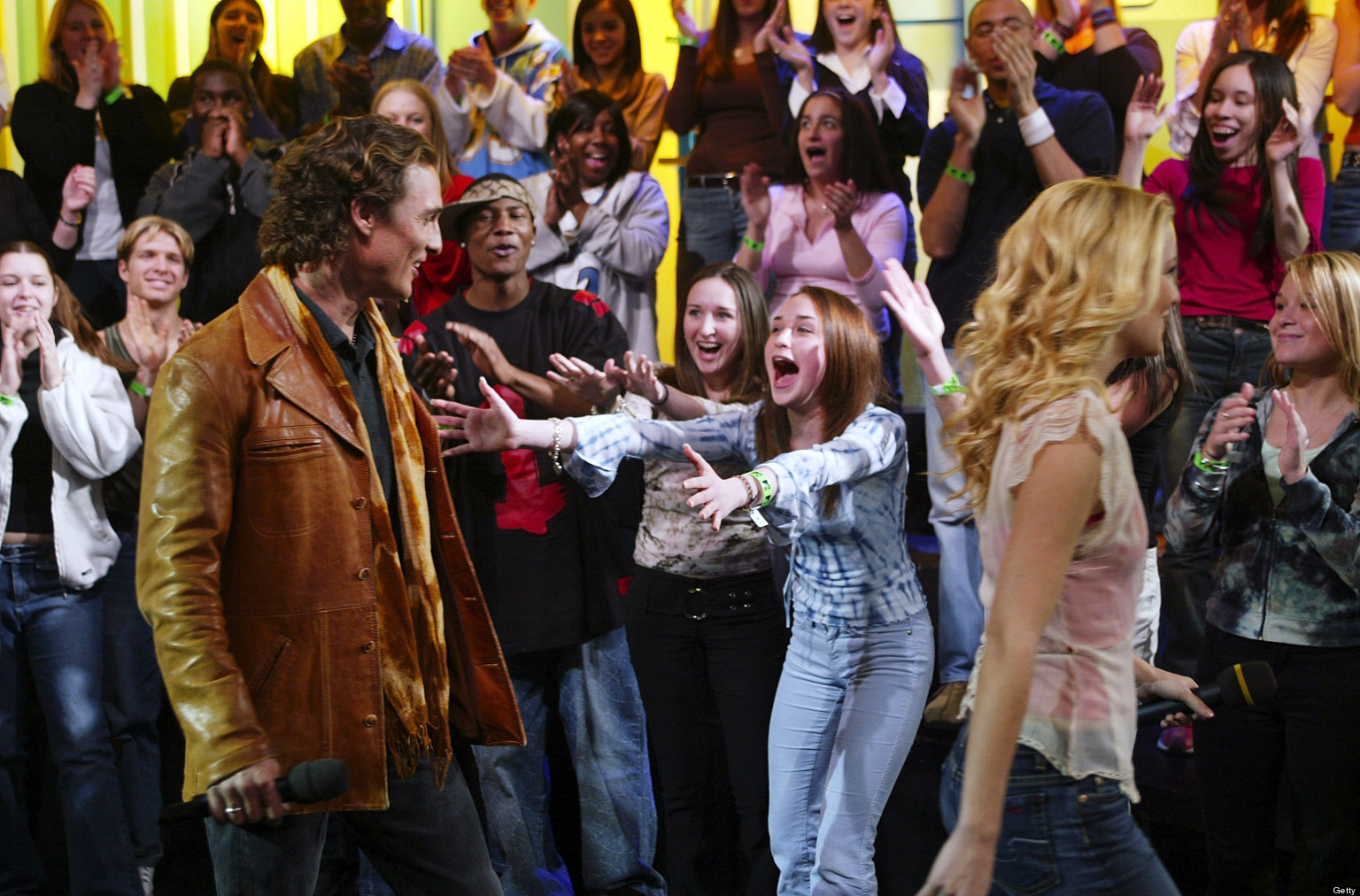
I've been thinking about the few celebrity encounters I've had, and I think I've been able to classify them into a few groups in terms of my own reactions to the meeting. I've included lists of celebrities based on my own feelings about celebrities, so I hope that the description of the group will suffice.
Group 1: The "Yikes"
Celebrities included in this group: Kim Kardashian, Tila Tequila, Perez Hilton.
Description: People you'd generally avoid. If they sat next to you on a bus, you'd slide a seat over. Not sure why, you just get that vibe. You get the sense that you would not be good friends with this person, just because.
Group 2: The "Eh."
Celebrities included: Ryan Seacrest, Jay Leno, Jessica Chastain, Roseanne Barr.
Description: If you were walking down the street and this person walks past, you could stop, but you're probably late to something. Or it couldn't hurt to be early.
Group 3: The "I think I care desperately about you despite never having seen you before now"
Celebrities included: Emma Stone, Meryl Streep, Dylan O'Brien.
Description: This is where it's at. Your celebrity crushes, the people you would love to have lunch with, and the people you'll fly across the country to see for 90 minutes in a cramped broadway theater.
Group 4: The "Oh... wait. WAIT. YOU'RE ON SHAMELESS."
Celebrities included: Brenda Song, Ewen McGregor.
Description: You don't care about these people individually, but they were in The Suite Life of Zach and Cody! or Moulin Rouge! How exciting! Maybe they're a gateway-star, where you could meet a group three-er like Nicole Kidman.
Group 5: The "Oh man I don't want to talk to you but my snapchat story needs you on it"
Celebrities included: Dylan and/or Cole Sprouse, Nicolas Cage.
Description: These are also celebrities that are, for all intents and purposes, irrelevant. But if you had a fleece blanket with their face on it, or if you tweeted a picture of the two of you together, the pure novelty of it would be a hoot!
Feel free to add categories in the comments!
Monday, April 27, 2015

Sunday, April 26, 2015
04/28/15 Reading Core Response #5
I personally enjoyed reading the essay, "Feminine Fascinations" by Jackie Stacey. Although some aspects of how the information about the stars circulate has changed enormously, I think her analysis on why the audience reflect themselves upon stars' images is still the same. They are a role model in various areas, especially for women, since the representation of women are often disregarded. I think due to the growth of women's economic and social power, women have more viewing power or ticketing power that can lead to potential consumption that are additional. Thus, movies that are chick flicks particularly about fashion, such as Sex and the City, has sequels, regardless of the quality of the movie. From reading the essay, I could not help but wonder about the recent trend of stardom, how it would fit in Stacey's argument of assimilation to the star image. I personally think although there are still mystification of stars, they are often more truthful to the star's original self and demystified due to the development of social media. Especially looking upon Instagram, stars post their lives without hesitation. Yes, some stars may get sponsors to promote certain products. However, the purpose of Instagram or other social media, which is to share one's life with others, makes these promotions quite realistic (and some stars may indeed feel the urge to share a great product with their fans or followers). But since what social media is doing is showing the true life of the stars, would the fascinations of the audience be geared towards these behind-the-scene moments of stars rather than a constructed image? Also, does these candid lives of stars contradict the image of the stars and affect the fascination of the audience? One thing from Stacey's essay that has also changed is the audience too. Due to the development of technology, audiences can now access diverse information about stars, and there are websites dedicated only to what stars wear. The audiences share and create resources that catering to variety of fascinations. Also, audiences got smarter in a sense that they can now decipher what is the image and what is the real life of the star. The rapid sharing of the encounters with celebrities or sharing by celebrities' insiders (friends and families) place the audience in control of what to consume of the image or not.
Core post #5: Loving Stars
In Jackie Stacey’s article, Feminine Fascinations: Forms of identification in star-audience relations, she underlines the different ways that women relate to their favorite actresses. She explains that this is a question of identification that can be separated to two different groups, fantasies and practices, even though they aren’t necessarily mutually exclusive and many times overlap.

In the first part of the article, Stacey explores the fantasies in which the audience fantasizes about their relationships with the star and that are most likely are related to the cinematic context instead of the star’s real persona.
Generally when the fantasy is based around devotion and worship, the spectators feel pleasure from “some kind of difference from the star” and “the distance produced by this difference” provides a “source of fascination” (Stacey, 149). Here, spectators often fantasize about the stars because it is seen as something unattainable and far away – which further perpetuates their image to perfection. In this case, quite often the spectator’s self is pushed to the side and never put in comparison to the star in an effort to diminish the gap between them.
In other cases, spectators feel the desire to become their idolized star – which is only made possible by the recognition of the self and the difference between spectator and star. This fantasy to become the star is many times knowingly unattainable, however still strongly felt by many fans. This perpetuates the “construction of the ideals of feminine attractiveness circulating in culture at any one time” since it mostly revolves around a star’s appearance (Stacey, 151). Female spectators also take pleasure in the star’s personalities and
behaviors within the cinematic context since it is something they lack
and desire in their own life. Many spectators also take pleasure in
escapism in order to be part of the star’s world.
I feel like fantasies used to be more common before the internet since stars used to be far more unreachable than nowadays. The internet offers new spaces and possibilities of contact; it serves as a bridge between the artist’s image and the spectators. Therefore, it is less common to see spectators that only live on fantasies and don’t contract from their idolized stars in some way.
The internet works for the humanization of the celebrity to the public. Fans can find out more about their idols online and may even feel like there is an intimate relationship. But is this a real relationship? Stars reveal only what is convenient for them. Moreover, it is not always the celebrity that updates their profile on social networks, feeding many fans a false “close relationship”. What fans meet is the representation of a celebrity, the true persona of a star is not revealed on the internet but rather a piece of their public figure. Their public exposition is chosen according to their interests and the entertainment industry’s, not the fans' curiosity.
In the second part, Stacey explores how these fantasies become practices as spectators take a step further and transform their identity in some way to diminish the gap between them and the idolized star. For that, they engage in pretending, resembling, imitating or copying in order to become closer to the star.
Pretending revolves around the imaginary factor since generally the spectator knows it is not true. For example, nowadays there are many online blogs where fans pretend to be part of a star’s world in a specific film or show, and generally many women in these websites rely on role-play to pretend to be their idolized star’s lover or best friend.
Other spectators rely on resemblance as a form of identification with their idolized stars. Even though it it isn’t a transformation, the spectator uses the association between the star and themselves centered on a physical feature that can make them alike. For example, a lot of magazines and blogs feature what stars are wearing and show where their look can be bought for you to look exactly like them. This is more pertinent to the female world because women generally tend to be more concerned with this aspect about their idolized star.

Many spectators take it a step further by imitating their stars in some way to fulfill their desire of becoming more like them and diminish the gap between them. For example, ever since Miley Cyrus posted a video on Facebook of her twerking routine to the song “Wop” by J. Dash, the act of twerking became a world-wide phenomenon for her fans. Especially after twerking during her tour, many fans started to post videos online trying to imitate her twerking.
Here's Miley Cyrus:
And here's a video of a fan trying to imitate and give a tutorial of Miley Cyrus' twerking:
Copying is different than imitating because it encompasses the transformation of physical appearance. Therefore, the “construction of women as cinema spectators overlaps here with their construction as consumers” (Stacey, 156). With the gap between stars and their spectators becoming increasingly smaller, the act of copying is increasing as fans see it as a way to be more sub-emerged in their idols world. Photoshop and the internet nowadays are working as props for young fans to insert themselves into a star’s life; making them increasingly more obsessed and more prone to going through some sort of physical transformation to be more similar to them. Before, we would see many people, unconsciously even, changing their hairstyle, to look like a specific big star of the time. But now, people are doing plastic surgery to look like their idols.
 |
| Donna 'Marie' Trego spent over $100k in plastic surgery to look like Lady Gaga |
 |
| Myla Sinanaj spent $30k to look like Kim Kardashian |
Core Post #5 - Copying Stars
In Jackie Stacey's article, “Feminine Fascinations: Forms of Identification in Star-Audience Relations,” she examines the different forms of cinematic and extra-cinematic identifactory fantasies/practices among female spectators. One form is copying, which is the attempt to transform physical appearances to look like stars. Copying, as Stacey discussed, is the most common form of this identifactory practice outside of cinema.
This "practice" reminds me of my writ340 classmate who recently colored her hair to look like Jamie Chung’s:

In essence, the spectator (my classmate) “attempts to close the gap between her image and her ideal image” by trying to produce a “new image, more like her ideal” (160); and her balayage hair is the focus on this transformation.
Also, many teens and young adults these days are trying to emulate Kardashians' qualities/styles--from Kylie Jenner’s lips to Khloe Kardashian’s hair. Recent news with teens using shot glasses and plastic bottles to replicate Kylie’s lips demonstrate what Stacey calls an “intersection of self and another.” These teens are trying to produce a desire to resemble the physically ideal, which in this case, are plump lips. Moreover, last year, there were all sorts of articles and tutorials created by stylists so viewers can re-create Khloe’s loose waves. While recently, Kim Kardashian posted on her Instagram showing her fans how she contours:


Celebrities like the Kardashians recognize that their followers are copying their looks and so they market their cosmetics and beauty products on social media in order to capitalize on their "brand power." Because stars are identified with particular commodities, spectators are involving self-transformations to produce appearances similar to their favorite stars--and by extension, they are adapting to the cultural ideas of femininity. As Stacey explained, “Closing the gap produced by the differences between stars and spectators is a source of pleasure expressed” (164).
This "practice" reminds me of my writ340 classmate who recently colored her hair to look like Jamie Chung’s:
In essence, the spectator (my classmate) “attempts to close the gap between her image and her ideal image” by trying to produce a “new image, more like her ideal” (160); and her balayage hair is the focus on this transformation.
Also, many teens and young adults these days are trying to emulate Kardashians' qualities/styles--from Kylie Jenner’s lips to Khloe Kardashian’s hair. Recent news with teens using shot glasses and plastic bottles to replicate Kylie’s lips demonstrate what Stacey calls an “intersection of self and another.” These teens are trying to produce a desire to resemble the physically ideal, which in this case, are plump lips. Moreover, last year, there were all sorts of articles and tutorials created by stylists so viewers can re-create Khloe’s loose waves. While recently, Kim Kardashian posted on her Instagram showing her fans how she contours:
(left: Khloe posing next to KBeauty hair products.
Right: Kim revealing her contouring make-up tricks on Instagram.)
Celebrities like the Kardashians recognize that their followers are copying their looks and so they market their cosmetics and beauty products on social media in order to capitalize on their "brand power." Because stars are identified with particular commodities, spectators are involving self-transformations to produce appearances similar to their favorite stars--and by extension, they are adapting to the cultural ideas of femininity. As Stacey explained, “Closing the gap produced by the differences between stars and spectators is a source of pleasure expressed” (164).
Alex Davis: Bruce Jenner & Wendy Williams (Suplemental Post)

Wendy Williams has made a career for herself out of critiquing and criticizing celebrities and star culture. She often refers to such judgement as an "opinion". I found her unfounded (and highly offensive) critique of Bruce Jenner to be highly inappropriate.
Her critique of Bruce's masculinity (or perception that he lacks masculinity because of his transition) hides her trans-phobic views in the name is celebrity culture. She points out that Bruce should have made the transition sooner, as to avoid having to tell it to his children.
She also mentions that Bruce is supposed to be the "rock" of the family. This statement not only furthers the misconception that masculinity means emotional strength, but it also limits those who identify as women to lesser subordinate domestic roles.

Wendy Williams uses the guise of a talk-show host to pander to those who view Bruce's transition as a ploy. Such views not only hurt Bruce, but undue years of work in the transgender community to combat such view. Masculinity does mean strength, and a women can lead a strong and guiding life just as any man would. Regardless of how you feel, such views do not belong on a daytime talkshow.
What do you think? Is this appropriate? As a successful black woman, what do these sentiments say about her opinions or how she views "traditional gender norms"? For me, I will be showing Wendy the door.

Core Blog Post #5: Judy Garland Lives On in the Gay Community
Richard Dyer's chapter on Judy Garland in Heavenly Bodies suggests that Garland's on and off screen persona in some ways represents "the situation and experience of being gay in a homophobic society" (149). The parallel between Garland as a real-life tragic figure and her film roles as a "comeback" performer allows audiences to see Garland as one who has been beaten by society, but still musters enough courage to defy it. Her additional brand of ordinariness, androgyny, and camp, also aligns Garland with gay culture and she has become somewhat of a gay icon. In fact, as early as World War II, being a "friend of Dorothy" was a slang term used by gay men to identify their sexual orientation when homosexual acts were illegal in the United States.
I feel that a great example of what Dyer talks about in HB can be seen in Garland's performance of "Get Happy" from Summer Stock (1950):
Garland's iconic costume from Summer Stock highlights the androgyny in her persona. She wears what appears to be a men's suit and fedora crossed with a skirt, stockings, and high heels. Meanwhile, men in traditional masculine costume serve as her background dancers, all of whom she complete power over as she leads the dance number. The visual gives new meaning to the lyrics of "Get Happy". For example, consider the chorus below:
Forget your troubles
Cone on get happy
You better chase all your cares away
Shout Hallelujah
Come on get happy
Get ready for the judgement day
The sun is shining
Come on get happy
The lord is waiting to take your hand
Should Hallelujah
Come on get happy
We're going to the promised land
We're heading across the river
Wash your sins away in the tide
It's so peaceful on the other side
I would argue that the image of an androgyne singing these lyrics (which have a religious connotation) implies gay acceptance in mainstream society. Garland sings of a peaceful land without judgement, and thus fear persecution for those that gender bend like she does.
This is similar to how Dyer discusses ways in which gays relate to Garland's role as Dorothy from The Wizard of Oz. In the film, Garland leaves an oppressive, black and white Kansas life to travel to a fantastic land of color, singing, and dance where all types of people could reach their true potential (Lion wants courage, Tin Man wants a heart, etc.). Perhaps a the land in which Garland talks about in "Get Happy" could be somewhat like Oz in which gays do not need to be held back by societal norms.
Garland's gender bending in "Get Happy" takes on new forms in modern times. For example, singer Rufus Wainwright recreates Dorothy's performance -- costume and all -- in his critically acclaimed Carnegie Hall Concert in 2007. Just last year, Seth Sikes emerged as a performer selling out shows by putting a modern spin on classic Garland songs.
I feel that a great example of what Dyer talks about in HB can be seen in Garland's performance of "Get Happy" from Summer Stock (1950):
Garland's iconic costume from Summer Stock highlights the androgyny in her persona. She wears what appears to be a men's suit and fedora crossed with a skirt, stockings, and high heels. Meanwhile, men in traditional masculine costume serve as her background dancers, all of whom she complete power over as she leads the dance number. The visual gives new meaning to the lyrics of "Get Happy". For example, consider the chorus below:
Forget your troubles
Cone on get happy
You better chase all your cares away
Shout Hallelujah
Come on get happy
Get ready for the judgement day
The sun is shining
Come on get happy
The lord is waiting to take your hand
Should Hallelujah
Come on get happy
We're going to the promised land
We're heading across the river
Wash your sins away in the tide
It's so peaceful on the other side
I would argue that the image of an androgyne singing these lyrics (which have a religious connotation) implies gay acceptance in mainstream society. Garland sings of a peaceful land without judgement, and thus fear persecution for those that gender bend like she does.
This is similar to how Dyer discusses ways in which gays relate to Garland's role as Dorothy from The Wizard of Oz. In the film, Garland leaves an oppressive, black and white Kansas life to travel to a fantastic land of color, singing, and dance where all types of people could reach their true potential (Lion wants courage, Tin Man wants a heart, etc.). Perhaps a the land in which Garland talks about in "Get Happy" could be somewhat like Oz in which gays do not need to be held back by societal norms.
Garland's gender bending in "Get Happy" takes on new forms in modern times. For example, singer Rufus Wainwright recreates Dorothy's performance -- costume and all -- in his critically acclaimed Carnegie Hall Concert in 2007. Just last year, Seth Sikes emerged as a performer selling out shows by putting a modern spin on classic Garland songs.
Janelle Monáe's Latest Reinvention (Supplemental Post)
Janelle Monáe just came out with a new single, "Yoga" last month. After listening to it one or nine times, I looked up the music video:
Before I saw the music video, I didn't know what to quite think of the song. Does it have grander thesis? I mean, I like yoga. And any time a song can feasibly work the word "areola" into the lyrics, I think it deserves mad respect. But I wanted to dig deeper into the meaning of the song.
The music video begins with Monáe by herself, levitating. The first lyrics of the song are transformed abruptly into a much lower pitch, but that doesn't stop her from saying them straight to the camera -- which is very jarring. The first verse is only Monáe with exclusively women of color, but by the end of the song, there is a whole group of what look to be a diverse crowd of both men and women. I was surprised to see more men in the video at the end -- We also transition from a private environment to a yoga studio, to finally a restaurant/ bar scene. This is a reversal of the typical male-dominated pattern I'm used to in a music video like this: A man and his crew will go to the club and take home girls they find there. Instead, Janelle Monáe takes her crew to the club and ends up dancing with everybody.
In an interview about the song recently, Monáe said this of the song and accompanying video:
“When I look to some of my heroes, Michael Jackson, Prince, and even Madonna, they never repeated themselves,” she explained. “They always figured out new ways to shock and to reinvent themselves. That’s what I’m going to do.”
The music video begins with Monáe by herself, levitating. The first lyrics of the song are transformed abruptly into a much lower pitch, but that doesn't stop her from saying them straight to the camera -- which is very jarring. The first verse is only Monáe with exclusively women of color, but by the end of the song, there is a whole group of what look to be a diverse crowd of both men and women. I was surprised to see more men in the video at the end -- We also transition from a private environment to a yoga studio, to finally a restaurant/ bar scene. This is a reversal of the typical male-dominated pattern I'm used to in a music video like this: A man and his crew will go to the club and take home girls they find there. Instead, Janelle Monáe takes her crew to the club and ends up dancing with everybody.
In an interview about the song recently, Monáe said this of the song and accompanying video:
“When I look to some of my heroes, Michael Jackson, Prince, and even Madonna, they never repeated themselves,” she explained. “They always figured out new ways to shock and to reinvent themselves. That’s what I’m going to do.”
What else might be going on in this music video?
Subscribe to:
Posts (Atom)