Showing posts with label Emily. Show all posts

Friday, May 1, 2015

Emily Huang Post #5 – Hollywood Women as Site of Social Struggle

In her article “The Hollywood Latina Body as Site of Social Struggle: Media Constructions of Stardom and Jennifer Lopez’s ‘Cross-over Butt’”, Mary Beltrán discusses the politics of representation that are attached to non-white celebrities, specifically their bodies, and how these function in a celebrity culture dominated by whiteness. Beltrán also examines the context in which these stars are operating, specifically in terms of how they cross over and the types of audiences they appeal to, something that correlated closely with how well the star embodied aspects of whiteness. The author then analyzes the hierarchies of power that are conferred through the existence of the white gaze, which refers to the power that white people have to control the way that nonwhite ethnicity is constructed in popular culture in the US. Beltrán then looks at the way this affects representations of characters of color and the way that white audiences receive them.

Through a lens focusing on the intersections of race and gender and their manifestations into bodies of color, Beltrán is able to connect the systems of domination and hierarchy around race and gender to the exoticization and sexualization of nonwhite bodies. Beltrán focuses on how this manifests in the conceptualizations of African-American and Latina women in black and brown bodies, especially when posited opposite whiteness. She points out that these stars must maintain a very particular look to fit into the white gaze and its perceptions of beauty. Whenever stars step out of this mold, they are punished for not fitting into it, and even when they do fit into the mold, they often lose their agency because of the way they are regulated.

When thinking about the way that this applies to Asian stars, it must be noted that the expectations that are placed on them differ from those placed on black and Latina stars. While black and brown bodies have been sexualized as “inviting”, Asian bodies have been constructed as “submissive” and hypersexualized as a “better” version of femininity alternative to white women, as related to the “model minority” stereotype, which has also used to reinforce antiblackness. This is seen in the ways that Asian characters have long been depicted as subservient, there to serve the needs of the men without raising a fuss (think of the Asian prostitute's “me love you long time” in Full Metal Jacket). Even today, few Asian female characters are depicted as passionate, independent women, when they even have nuanced character portrayals at all. The few female Asian stars that have become more notable are still weighed down by the white gaze that keeps them in that box, which points to the desperate need for more representation that is not crippled by stereotypes and a hurtful, exploitative construction of Asian femininity.

Emily Huang Post #4 – Identification with stars in gay culture

In her essay, “Feminine Fascinations: Forms of identification in star-audience relations”, Jackie Stacey dissects the ways in which audiences, especially female viewers, connect to the stars they are watching. Stacey discusses the concept of identification and how it functions as the main venue through which identities are produced. She critiques the theories that have thus far been used to explain the processes of identification through a psychoanalytic lens, and then recognizes the wider definitions of identification as through connecting to a character’s point of view or by empathizing or sympathizing with a character. Stacey then goes on to examine these theories in real life by looking at firsthand accounts of female viewers of their favorite stars, and assesses them to glean a number of common themes.

While I found this to be interesting, I also wondered what it would be like if the letters referenced had come from non-normative perspectives, specifically from queer female perspectives. Queer individuals face an extra layer of complexity when navigating same-gender friendships and relationships, especially within the context of the highly interconnected queer community. One of the mentioned requirements for identification was that the viewer did not view a connection with the star in the context of sexual attraction. My question is, if stars provide examples for audiences to look up to, how might the aspects of identification change when the contexts of connection are different?

Ellen DeGeneres - TV host, comedian, actress
Angel Haze - rapper, singer

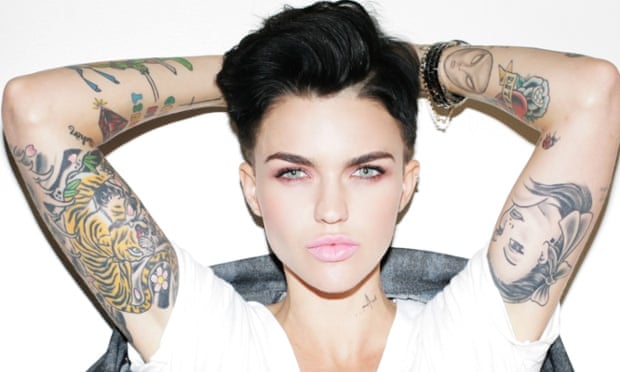
Ruby Rose - DJ, actress, model
Ellen Page - actress
Queer women look up to openly queer stars for a variety of reasons. Through her examination of the letters she gathered from female viewers for analysis, Stacey discusses the themes she saw in her respondents’ experiences as being devotion and worship, the desire to become, pleasure in feminine power, identification and escapism, pretending, resembling, imitating, copying, and how copying intersects with consumption. As reflected on websites like Autostraddle or AfterEllen that focus on queer female culture, queer women also look to their stars for everything from style to inspiration, but also as visible examples of representation for their identities. However, the difference is that queer women are also navigating the way they view stars as possible objects of desire, and this becomes even more complicated when there are so few openly queer female celebrities. How might theories of identification change when the question becomes, “Do I want to be her, or do I want to be with her?”

Monday, April 6, 2015

Emily Huang Post #3 - Star Bodies: How today's heroines subvert the gender binary

Paul McDonald’s supplementary chapter to Richard Dyer’s Stars seeks to expand upon Dyer’s original theories on the social meaning of the star image. When analyzing the importance of the physical manifestation of star bodies, McDonald references Fiona Tasker’s work on the heroines played by Sigourney Weaver in Alien and Linda Hamilton in Terminator 2: Judgment Day, claiming that the physicality of these female bodies serves to cross the traditional divide between masculine and feminine bodies in film and allowing these heroines to occupy roles comparable to those of male action heroes. While I understand McDonald’s intent in designating this phenomenon as the disruption of the gendered binary, I would argue that these types of heroines do not necessarily subvert the binary, but that they instead serve to imitate the type of heroic masculinity to an extent, often failing even to achieve this fully. For example, while Linda Hamilton’s character in Terminator 2, Sarah Connor, is depicted as having resilience and physical strength, it is still no match for that of either of the Terminators in the film who take turns overpowering or saving Sarah and John Connor.

In contrast, several of today’s heroines such as Katniss Everdeen from The Hunger Games and Tris Pryor from Divergent do a much better job of actually subverting the gendered binary that has long determined a character’s narrative.

Rather than seeking only to imitate the storylines of the muscular heroes of the past with strength as their notable characteristic, these heroines do not draw merely from the binary, but queer their characters by defining them across and outside the spectrum. While both the embodiments of Katniss and Tris are not physically unfit, they are also acknowledged as being much weaker than many of their opponents or counterparts, such as Cato and Thresh in The Hunger Games and Peter and Molly in Divergent. Katniss has little of the physical training or experience with weaponry that the Careers have grown up with, and Tris does not have the physical strength to match her opponents in fights.
Thus, rather than winning their fights with brute force, Katniss and Tris must draw from other skills and strengths to cement their status as heroines. Without depending on physical strength in their respective stories, neither of these characters is depicted as weak. Katniss’s skill as an archer is paired with her emotional and physical resilience, driven by her empathy and protective nature.
Tris’s ability to overcome her fears makes her a leader among her fellow initiates, and her bravery and strategic vision allow her to finish at the top of her initiate class.


Katniss's friendship with Rue helped her gain allies and started an uprising in The Hunger Games
Tris's strategic thinking wins the Capture the Flag event for her team 
Without relying on the stereotyped gendering of protagonists so prevalent in past narratives, Katniss and Tris are the heroes of the present. Neither is reliant on their male counterpart, with Katniss and Tris even having to rescue Peeta and Four, respectively. However, this does not just mean that the roles are switched, because the relationships between these characters is an equal partnership rather than just a flipped version of the knight in shining armor rescuing the damsel in distress. By queering the way that their characters are defined and relate to those around them, these heroines do a much better job in subverting the gender binary of the hero narrative.

Monday, February 2, 2015

Emily Huang Post #2 - Consuming stars and their types

The relationship that the public has in its consumption of stars is a tenuous one; depending on the day, it may fluctuate between admiration, envy, and criticism. We obsess over even minute details of a star's possessions, wardrobe, or daily motions, seeking connections to celebrities that we have never met and who likely will never know our names. Why is this? Dyer explains that this obsession over stars stems from the myth of success, which posits that American society makes success possible for anyone with the right combination of talent and luck, regardless of their rank or status. To the public, stars represent the epitome of the American Dream, one that anyone may achieve.
Because of this elevated status that the adoring public places upon stars, the associated spotlight then encourages the public to scrutinize celebrities in hopes of finding ways to become like them. In seeking to understand who a star is, society then also attaches labels to them as a way to categorize, describe, and simplify their persona into something that is more easily idolized and consumed. Dyer refers to these in the social types defined by O.E. Klapp that describe several of the personas beloved by the dominant society. These social types, which include the Good Joe, Tough Guy, and Pin-Up, have remained prevalent for decades. This is especially noticeable in the way that characters or personas that do not fit into these dominant, palatable types are often pointed out and designated as “others” in some way, whether because they are rare, go against the longstanding norms, or do not adhere to stereotypes. Forms of othering are seen in the distinctions of characters or personas as grounded in value systems that are alternative to the dominant system, and these are the personas that tend to draw more criticism because they challenge normative values. Examples of these types are the Rebel and the Independent Woman.
Recently, characters that fit into these alternative types have seen a rise in their incorporation and portrayals in popular media, and their real life counterparts often enjoy a similar rise in popularity. Recognizing the changing values and views of mainstream society is key to understanding this shift and how it is a reflection of what individuals in the public are able to identify with. By knowing the personas that the public connects stars to, we are able to see how our society personifies the ideals and values of today. 

Monday, January 19, 2015

Emily Huang Response #1

Dyer’s analysis of stars as a phenomenon of production was particularly fascinating to me in its explanation of how celebrities are constantly playing myriad roles and positions, something that is also reframed when examining the ways in which celebrities are consumed in culture. One of the greatest paradoxes of the concept of celebrity is that of human or not – stars are at once mythical figures walking down red carpets clad in dresses or stepping out of cars that we can only dream of owning, while being at the same time relatable people who frequent the same coffee shops and gyms that we, the “normal” people do. The obsession over celebrities serves to further this contrast, dehumanizing a star by turning their persona into a perfect ideal that can be projected upon, while keeping them as the idols we aspire to be with, be among, or become. This, along with the knowledge that a star is still a real, imperfect person, results in a warped perception of what of their image is produced and what is untainted.

This conflict between person versus object extends beyond public perception into the world of production itself. Dyer discusses how “stars represented a form of capital possessed by the studios,” mere pawns used to market a film or guarantee its worth as an investment (10). Describing a human as capital, an investment, or having market value is not the typical venue in deciding human worth, but rather the way to define something that human beings have produced or have the potential to produce. It could be argued that it is the star’s talent or abilities that this then refers to, but many people have talents that production industries will not seek to claim because they must be attached to a marketable persona to become valuable.


This paradox brings me to question the benefits and detriments of its effects, wondering if stardom and celebrity are ultimately harmful to the stars themselves, or to the public that adores them. We already are privy to (and hungrily consume) the stories of stars that cannot handle the pressure, whether they break down, gain a few pounds, or battle with addiction. How might these negative effects stem from the precarious positions we place our celebrities in, and how does this obsession with perfect imperfection reflect on our own struggles for validation?